 Brome Compost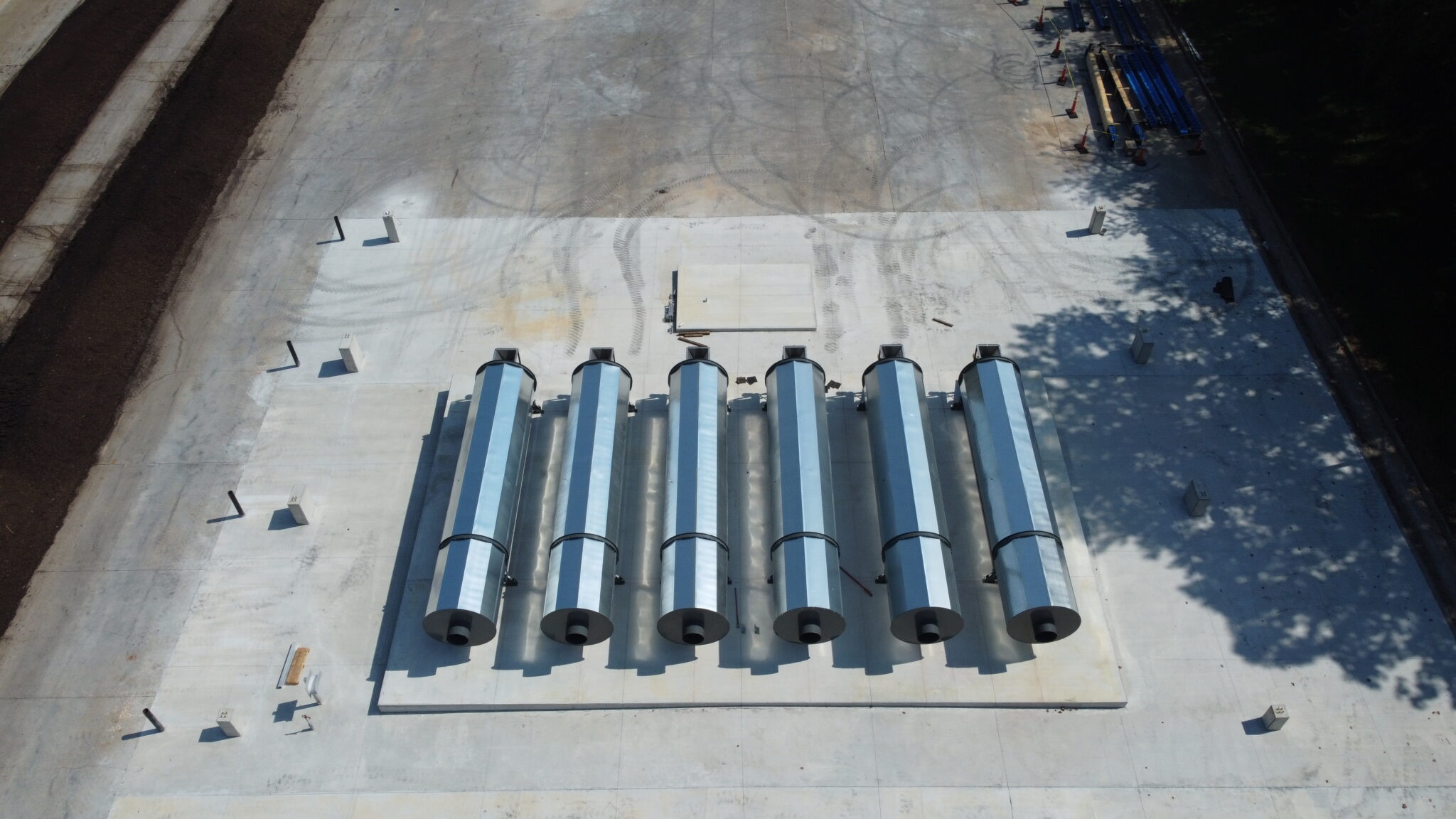
Bentonville Biosolids Composting: Measurable Results from a Data-Driven Transformation
Municipal biosolids management is evolving. Cities must now balance environmental performance, community acceptance, operational efficiency, and long-term scalability—often within existing infrastructure constraints.
The City of Bentonville, Arkansas, provides a clear example of how transitioning from a traditional windrow system to an enclosed, controlled composting process can deliver measurable improvements across all of these dimensions.
After two years of operation, the results are clear, quantified, and directly relevant to municipal decision-makers.
A system under pressure: the municipal reality
Like many growing communities, Bentonville faced increasing demands on its wastewater and residuals infrastructure. Population growth, rising disposal costs, and the need for long-term capacity planning were combining with operational challenges on the composting site.
The facility operated on approximately 10 acres and processed both biosolids and yard waste. While the system was functional, it depended heavily on weather conditions and required significant space and labor.
At the same time, odor complaints from surrounding communities and aging infrastructure were creating both operational and reputational pressures.
Before: limitations of open-air windrow composting
Prior to 2023, biosolids composting was performed using aerated windrows:
- Approximately 600 tonnes/year of biosolids processed
- Large open-area composting pad
- Heavy reliance on climate conditions
- Regular mechanical turning (SCARAB system)
This system presented several limitations:
- Odor generation and nuisance complaints
- High footprint relative to capacity
- Labor-intensive operations
- Exposure to weather variability
- Increasing maintenance and replacement costs
For many municipalities, this reflects a common situation: systems that were once adequate become constrained as growth and expectations increase.
Transition to a controlled and optimized process
The implementation of an enclosed, in‑vessel composting system shifted operations from a reactive model to a controlled, data-driven process.
The objective was not only to solve odor issues, but to fundamentally improve:
- Throughput capacity
- Operational stability
- Workforce safety
- Site efficiency
- Long-term scalability
This transition was supported by pilot testing and phased implementation, ensuring that the system would deliver consistent and measurable results.
What the data showed: measurable municipal benefits
1. Odor control and community acceptance
One of the most immediate and visible outcomes was odor reduction.
- Up to 90% reduction in odor impacts
- Zero complaints recorded after implementation
- Significant decrease in nuisance factors such as flies and vectors
For municipalities, this is critical:
- Improved community relations
- Reduced risk of regulatory pressure
- Stronger public acceptance of biosolids programs
Odor is often the primary barrier to project approval—this result directly addresses that challenge.
2. Optimization of volumes treated and throughput capacity
One of the most significant outcomes is the ability to increase volumes treated while maintaining control.
- Throughput capacity increase of +50% to +100%
- Annual treatment capacity effectively doubled (from ~600 to ~1,200 tonnes/year in comparable periods)
- +44% increase in biosolids input (Q1 year-over-year)
These results demonstrate:
- Higher utilization of infrastructure
- Ability to absorb growth without expanding footprint
- Improved processing consistency across seasons
For municipalities, this translates directly into:
- Deferred capital expansion
- Better return on infrastructure investment
- Greater resilience to population growth and fluctuating waste streams
3. Footprint reduction and land-use efficiency
Land availability is one of the most limiting factors for biosolids management.
Bentonville’s transformation shows a major improvement:
- Significant reduction in required composting footprint
- Compression of active processing areas
- Increased treatment density per square meter
The operational layout moved from widely distributed windrows to a more compact, controlled configuration.
Key takeaway:
The site can now treat more material using significantly less space.
For municipalities, this is especially valuable in:
- Urban or peri-urban environments
- Sites with limited expansion possibilities
- Facilities facing buffer zone constraints
4. Operational stability and process control
The transition to an enclosed system resulted in a major shift in operational reliability:
- Year-round operation, independent of weather
- Controlled temperature, moisture, and residence time
- Consistent treatment cycles (e.g., 8–9 day processing windows)
- Structured operating cadence (multiple cycles per day, 6 days per week)
This leads to:
- Predictable output
- Reduced variability
- Easier planning and scheduling
For municipal operators, this reduces uncertainty and increases confidence in meeting regulatory and production targets.
5. Health, safety, and workforce conditions
The closed process significantly improves working conditions:
- Reduced exposure to bioaerosols and pathogens
- Less direct handling of material
- Safer work environment with mechanized and automated processes
- Reduced need for manual turning operations
These improvements are often overlooked but are critical for:
- Workforce retention
- Compliance
- Long-term operational sustainability
6. Biosolids quality and regulatory performance
The system consistently achieves:
- EPA Class A biosolids standards
- Improved pathogen reduction through controlled thermal profiles
- More stable and uniform compost product
For municipalities, this supports:
- Beneficial reuse strategies
- Reduced disposal dependency
- Greater market acceptance of the final product
7. System scalability and long-term resilience
Beyond immediate gains, Bentonville’s system demonstrates scalability:
- Ability to increase throughput without redesign
- Flexibility to adapt to changing feedstock volumes
- Improved alignment with long-term infrastructure planning
The system becomes not just a processing unit, but a strategic asset for future growth.
What this means for municipalities
The Bentonville case demonstrates that optimizing biosolids composting is not just about solving operational issues—it is about redefining performance.
By transitioning to a controlled, enclosed system, municipalities can simultaneously:
- Reduce community impacts
- Increase treatment capacity
- Optimize land use
- Improve reliability and safety
- Strengthen regulatory compliance
Most importantly, these improvements are measurable, repeatable, and scalable.
Conclusion: from constrained operations to optimized performance
Bentonville’s experience shows that modern biosolids composting is no longer limited by the trade-offs of traditional systems.
Instead, municipalities can achieve:
- Higher throughput
- Lower footprint
- Better environmental performance
- Stronger community acceptance
All at the same time.
This shift—from reactive to data-driven operations—is what defines the next generation of municipal biosolids management.


